What Lesotho loti actually arrives in Lesotho when someone sends Australian dollars, at the live mid-market rate. We explain the process; we never recommend a provider.
1 AUD =
11.53LSL
▲ +0.12%
STRUCK 11:00 AEST · TUE 13 OCT
11.6911.5411.4
16 Jul2 Sep13 Oct
What you receive at the mid-market rate
They send (AUD)
You receive at mid-market (LSL)
500 AUD
5,765 LSL
1,000 AUD
11,530 LSL
2,000 AUD
23,060 LSL
5,000 AUD
57,650 LSL
Mid-market equivalents, not transfer quotes - the sender’s provider deducts its margin and any fees before the money reaches you. STRUCK 11:00 AEST · TUE 13 OCT.
Country reference
Lesotho
ISO LS · LSO · Africa
CAPITAL
Maseru
POPULATION
2,363,325 (2025)
LEGAL TENDER
Lesotho loti (LSL · L) and South African rand (ZAR · R)
AREA
30,355 km²
OFFICIAL LANGUAGES
English, Sesotho
CALLING CODE
+266
TIME ZONES
UTC+02:00
A mountain kingdom entirely surrounded by South Africa, Lesotho is the only country in the world that sits wholly above 1,000 metres. Locals ride sure-footed ponies and wrap up in bright Basotho blankets.
It's one of only three countries completely surrounded by a single other nation.
Its entire territory lies above 1,000 metres, the highest low point of any country on Earth.
It has the highest single-drop waterfall in southern Africa, Maletsunyane Falls.
The colourful Basotho blanket is a national symbol worn as everyday clothing.
WHAT THE FLAG MEANS
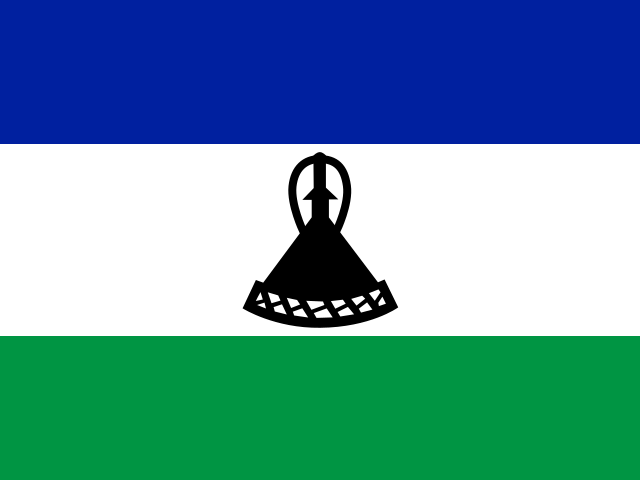
Three horizontal stripes of blue, white and green, the white one wider than the other two in the proportions three to four to three, with a black mokorotlo, the Basotho hat, centred on it. The constitution only refers the national flag to an Act of Parliament, and requires two-thirds of all the members of the National Assembly to send such a bill to the King for assent. The National Flag Act that resulted describes the design, the proportions and the Pantone colours, and assigns none of it a meaning; nor does the constitution. The blue is conventionally read for rain, the white for peace and the green for prosperity, with the hat for the Basotho people themselves. The flag dates from the fortieth anniversary of independence in 2006.
Population SOURCE Wikidata · flag meaning audited against each country’s own governing instrument · flag: flag-icons (MIT)
A continent pretending to be a country - Australia is the only nation that fills an entire continent, with most of its 27 million people clinging to the coast while the red-dirt interior does its own thing.
It's home to the Great Barrier Reef, the largest living structure on Earth.
Around 80% of its mammals, including the kangaroo and koala, live nowhere else on the planet.
Canberra was purpose-built as a compromise capital because Sydney and Melbourne couldn't stop arguing over the honour.
It has more kangaroos than people.
WHAT THE FLAG MEANS
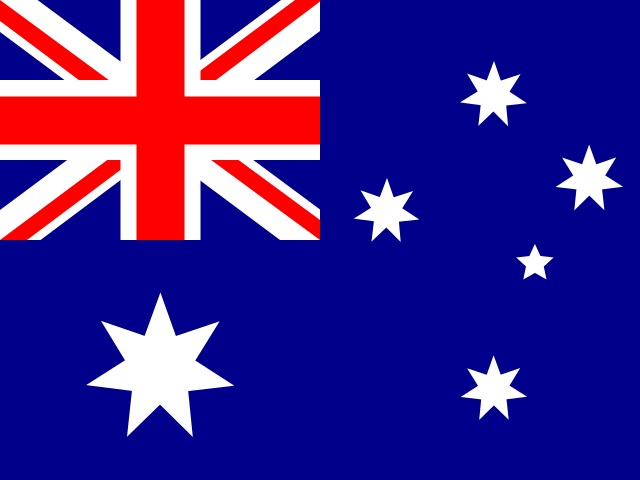
A blue field with the Union Jack in the canton, a large white seven-pointed Commonwealth Star below it, and the five white stars of the Southern Cross at the fly. Six of the big star's points stand for the states and the seventh for the territories; the Southern Cross marks Australia's place in the southern sky.
Population SOURCE Wikidata · flag meaning audited against each country’s own governing instrument · flag: flag-icons (MIT)
The receiver’s side of this corridor
The loti is fixed one for one with the South African rand, and rand notes are legal tender inside Lesotho, so shops treat the two as the same money. Lesotho sits entirely within South Africa, and wages earned across that border support a great many households at home.
The exchange rate is set on the sending side - by the service the sender chooses in Australia - so the most useful thing a receiver can do happens before the transfer: share the live mid-market rate on this page so the sender can judge the margin in their quote. How the money arrives in Lesotho determines any local receiving charges - bank-to-bank transfers can pass through intermediary banks that deduct handling fees.
What the central bank's own figures say about how money actually arrives
Most of the money reaching Lesotho has historically arrived outside the payment system altogether, and the country's own central bank has put figures on it. A study written by the head of national payment system oversight at the Central Bank of Lesotho records inward remittances of six billion rand in 2015, of which only about one billion is estimated to have been remitted through regulated channels. The unregulated remainder moves as cash carried across the border by bus, truck and taxi operators, or in hand by the migrants themselves.
That informal channel has a procedure, and it is worth knowing what it does not require. The sender gives the recipient's phone number so the operator's office at the border post can call when the funds are ready for collection; the same study records that recipients are not asked to present any identification document at the terminal, and that a late collection charge applies if they do not arrive at the agreed time.
Beside it the same study describes a statutory scheme with no counterpart in the neighbouring countries. Under the Deferred Pay Act, it records, mineworkers in South Africa remitted a fixed share of pay to family in Lesotho, or a variable sum through a cash remittance system, and in both cases a thumbprint was required to identify the recipient, one the study notes is not digital. Everything in the two paragraphs above is that study's account as at its 2018 publication, and this page does not assert the proportions still hold.
What is current is narrower and better dated. Where money arrives in a mobile wallet, the Central Bank of Lesotho set revised limits with effect from 1 September 2023 which turn on how fully the holder has been identified: a partially identified holder is verified on full names and a national identity document and carries lower daily and monthly ceilings than one identified to the full standard under the money laundering statute.
A little less than the mid-market figures above. The service the sender uses in Australia sets the rate and fees; local receiving banks in Lesotho can also apply their own charges depending on how the transfer arrives.
The sender asked for my details - what will they need?
Whatever their transfer service asks for on the receiving side - typically your full legal name and local bank account details in Lesotho. Give the name exactly as your bank records it; mismatches are the most common reason a transfer is delayed.
Why did I receive less than the rate on this page suggests?
A quote is the mid-market rate with the provider’s margin taken out of it. Because that margin is expressed in the rate rather than itemised, it is easy to miss and is usually the bigger half of what a transfer costs. On a bank-to-bank transfer an intermediary bank can also deduct a handling charge in transit.