What Haitian gourde actually arrives in Haiti when someone sends Australian dollars, at the live mid-market rate. We explain the process; we never recommend a provider.
1 AUD =
91.12HTG
▼ -0.02%
STRUCK 11:00 AEST · TUE 13 OCT
94.2692.3990.51
16 Jul2 Sep13 Oct
What you receive at the mid-market rate
They send (AUD)
You receive at mid-market (HTG)
500 AUD
45,560 HTG
1,000 AUD
91,120 HTG
2,000 AUD
182,240 HTG
5,000 AUD
455,600 HTG
Mid-market equivalents, not transfer quotes - the sender’s provider deducts its margin and any fees before the money reaches you. STRUCK 11:00 AEST · TUE 13 OCT.
Country reference
Haiti
ISO HT · HTI · North America
CAPITAL
Port-au-Prince
POPULATION
11,906,095 (2025)
CURRENCY
Gourde (HTG · G)
AREA
27,750 km²
OFFICIAL LANGUAGES
French, Haitian Creole
CALLING CODE
+509
TIME ZONES
UTC-05:00
The first nation founded by people who freed themselves from slavery, Haiti won independence in 1804 after the only successful large-scale slave revolt in history, sharing the island of Hispaniola with the Dominican Republic.
In 1804 it became the world's first independent nation founded by formerly enslaved people.
It was the second country in the Americas, after the United States, to declare independence.
It shares the island of Hispaniola with the Dominican Republic.
The mountaintop Citadelle Laferriere is one of the largest fortresses in the Americas.
Its name comes from an Indigenous Taino word meaning 'land of high mountains'.
WHAT THE FLAG MEANS
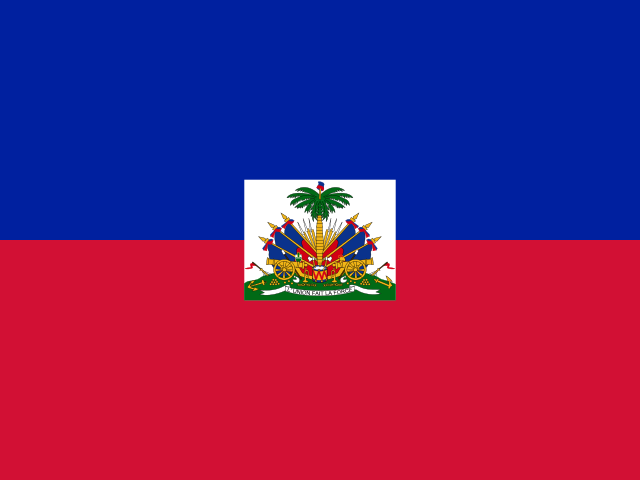
Two horizontal bands of blue over red bearing the national coat of arms on a central white square: a royal palm crowned with the liberty cap, shading a trophy of arms, and the motto 'L'Union Fait La Force'. Article 3 of the constitution describes the flag and the arms in those terms and assigns them no meaning, though the 1986 decree that restored the bicolour calls it the true symbol of national unity. The flag is traditionally said to have been made by taking the white out of the French tricolour, and the blue and red read as the union of the nation's Black and mixed-race citizens.
Population SOURCE Wikidata · flag meaning audited against each country’s own governing instrument · flag: flag-icons (MIT)
A continent pretending to be a country - Australia is the only nation that fills an entire continent, with most of its 27 million people clinging to the coast while the red-dirt interior does its own thing.
It's home to the Great Barrier Reef, the largest living structure on Earth.
Around 80% of its mammals, including the kangaroo and koala, live nowhere else on the planet.
Canberra was purpose-built as a compromise capital because Sydney and Melbourne couldn't stop arguing over the honour.
It has more kangaroos than people.
WHAT THE FLAG MEANS
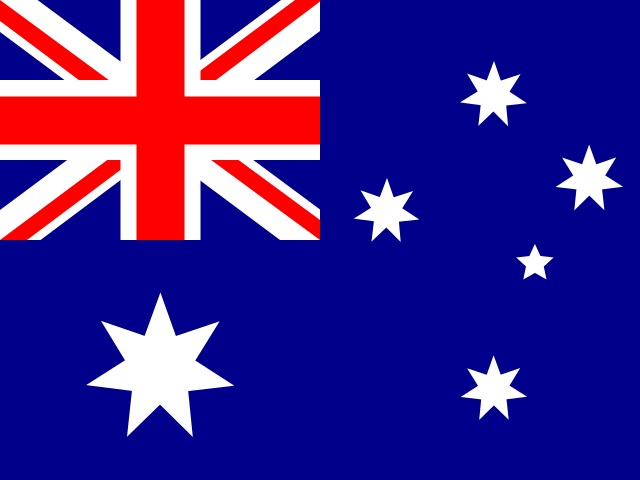
A blue field with the Union Jack in the canton, a large white seven-pointed Commonwealth Star below it, and the five white stars of the Southern Cross at the fly. Six of the big star's points stand for the states and the seventh for the territories; the Southern Cross marks Australia's place in the southern sky.
Population SOURCE Wikidata · flag meaning audited against each country’s own governing instrument · flag: flag-icons (MIT)
The receiver’s side of this corridor
Prices in Haiti are often spoken in “Haitian dollars”, an informal unit of account worth five gourdes, so a figure quoted in conversation may not be the figure a bank would use. US dollars circulate alongside the gourde, and banking access outside the main cities is thin, which shapes how money is collected.
The exchange rate is set on the sending side - by the service the sender chooses in Australia - so the most useful thing a receiver can do happens before the transfer: share the live mid-market rate on this page so the sender can judge the margin in their quote. How the money arrives in Haiti determines any local receiving charges - bank-to-bank transfers can pass through intermediary banks that deduct handling fees.
The gourde payout rule, and the receipt you are owed
Haiti does not leave the payout currency to the beneficiary and it does not leave the rate to the counter. A circular of the Banque de la République d'Haïti requires banks and transfer houses to pay international transfers in gourdes at all their service points, whether a branch, an agency, an office or a kiosk, or onto a payment instrument. It then fences the rate they may use from both directions: in no case may it be below the reference rate the central bank calculates, and in no case may it exceed the midpoint between that reference rate and the average acquisition rate. The instrument dates from August 2022 and replaced an earlier one from 2020.
That direction of travel is worth knowing, because it reversed. The circular in force in 2019 required exactly the opposite, that banks and transfer houses pay transfers received in the currency the sender specified, with local currency available only if the beneficiary asked for it. The reversal came in 2020 and has been carried forward since.
The same rules give a recipient two things to hold the counter to. On paying a transfer, the institution must identify its client in accordance with the laws in force and hand over a receipt. That receipt carries, among other things, the amount, the currency the transfer was paid in, the exchange rate of the transaction, the name of the bank or transfer house and the address of the point of service. And a transfer house must display the rate it is applying visibly in its premises, and ensure the same is displayed at every point of service its sub-agents run.
Who may be a sub-agent is limited by name as well as by category. Banks and transfer houses contract sub-agents by representation contract and remain liable to the client for that network whatever the contract says. Commercial businesses operating in games of chance, the rules name lotteries, borlettes and casinos, may not be sub-agents of any financial institution. Sub-agents must display their status and the institution they act for on their premises, and the Bank publishes its own list of licensed transfer houses.
A little less than the mid-market figures above. The service the sender uses in Australia sets the rate and fees; local receiving banks in Haiti can also apply their own charges depending on how the transfer arrives.
The sender asked for my details - what will they need?
Whatever their transfer service asks for on the receiving side - typically your full legal name and local bank account details in Haiti. Give the name exactly as your bank records it; mismatches are the most common reason a transfer is delayed.
Why did I receive less than the rate on this page suggests?
A quote is the mid-market rate with the provider’s margin taken out of it. Because that margin is expressed in the rate rather than itemised, it is easy to miss and is usually the bigger half of what a transfer costs. On a bank-to-bank transfer an intermediary bank can also deduct a handling charge in transit.