Receiving Australian dollars in the West African CFA franc zone
What West African CFA franc actually arrives in the West African CFA franc zone when someone sends Australian dollars, at the live mid-market rate. We explain the process; we never recommend a provider.
1 AUD =
408.16XOF
▼ -0.02%
STRUCK 11:00 AEST · TUE 13 OCT
408.24403.69399.13
16 Jul28 Aug13 Oct
What you receive at the mid-market rate
They send (AUD)
You receive at mid-market (XOF)
500 AUD
204,080 XOF
1,000 AUD
408,160 XOF
2,000 AUD
816,320 XOF
5,000 AUD
2,040,800 XOF
Mid-market equivalents, not transfer quotes - the sender’s provider deducts its margin and any fees before the money reaches you. STRUCK 11:00 AEST · TUE 13 OCT.
Currency reference
The West African CFA franc zone
CURRENCY · WEST AFRICAN CFA FRANC (XOF · F CFA)
The West African CFA franc is issued for eight countries by a single central bank in Dakar and is held at a fixed rate against the euro. It shares that rate, and its name, with the Central African CFA franc - but the two are separate currencies and notes from one zone are not spendable in the other, so confirm which one a recipient actually banks in.
A continent pretending to be a country - Australia is the only nation that fills an entire continent, with most of its 27 million people clinging to the coast while the red-dirt interior does its own thing.
It's home to the Great Barrier Reef, the largest living structure on Earth.
Around 80% of its mammals, including the kangaroo and koala, live nowhere else on the planet.
Canberra was purpose-built as a compromise capital because Sydney and Melbourne couldn't stop arguing over the honour.
It has more kangaroos than people.
WHAT THE FLAG MEANS
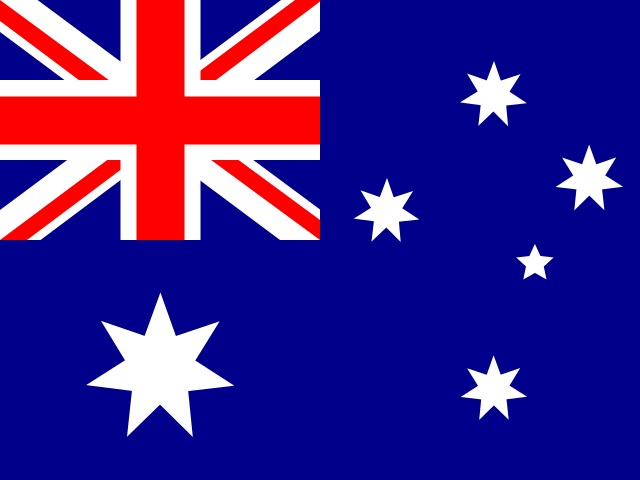
A blue field with the Union Jack in the canton, a large white seven-pointed Commonwealth Star below it, and the five white stars of the Southern Cross at the fly. Six of the big star's points stand for the states and the seventh for the territories; the Southern Cross marks Australia's place in the southern sky.
Population SOURCE Wikidata · flag meaning audited against each country’s own governing instrument · flag: flag-icons (MIT)
The receiver’s side of this corridor
Eight West African countries share this franc, issued by a single central bank in Dakar and held at a fixed rate against the euro, so the pair follows the Australian dollar against the euro. It is a different currency from the Central African CFA franc despite the matching name and value.
The exchange rate is set on the sending side - by the service the sender chooses in Australia - so the most useful thing a receiver can do happens before the transfer: share the live mid-market rate on this page so the sender can judge the margin in their quote. How the money arrives in the West African CFA franc zone determines any local receiving charges - bank-to-bank transfers can pass through intermediary banks that deduct handling fees.
A value ceiling decides which system an arriving payment lands on. The regional bulk system handles transfers, cheques and commercial bills through nine separate clearing arrangements, one for each member state plus a regional one, and stops at fifty million CFA francs. Anything larger goes to the real-time gross settlement system, which the central bank of the West African states has run since June 2004 for transactions of systemic scope. Its participants are named on the bank's own page: the region's banks and financial institutions, the regional stock exchange's depository, the interbank card grouping and the regional development bank.
Foreign currency is handled at one point in that chain instead of throughout it. The central bank records that the real-time system processes international transfers in foreign currencies through the central bank participant, for cover in CFA francs. The conversion has an institutional home, and money arriving from outside the region reaches it through that participant.
Since the end of September 2025 there has been a third layer. The central bank opened an interoperable instant payment platform running continuously and taking in banks, electronic money establishments, microfinance institutions and payment establishments, setting the institutions it covers a deadline of the end of June 2026 to be connected and serving customers. None of the member states appears among the ISO 13616 formats in the IBAN registry, so an account is identified by the bank's identifier code and the account number.
How much West African CFA franc will I receive in the West African CFA franc zone?
A little less than the mid-market figures above. The service the sender uses in Australia sets the rate and fees; local receiving banks in the West African CFA franc zone can also apply their own charges depending on how the transfer arrives.
The sender asked for my details - what will they need?
Whatever their transfer service asks for on the receiving side - typically your full legal name and local bank account details in the West African CFA franc zone. Give the name exactly as your bank records it; mismatches are the most common reason a transfer is delayed.
Why did I receive less than the rate on this page suggests?
The mid-market rate is the midpoint between global buy and sell prices, and no retail provider deals at it. The gap between it and a quote is the provider’s margin, which is usually where most of the cost of a transfer sits. On a bank-to-bank transfer an intermediary bank can also deduct a handling charge in transit.