What Turkmenistani manat actually arrives in Turkmenistan when someone sends Australian dollars, at the live mid-market rate. We explain the process; we never recommend a provider.
1 AUD =
2.4401TMT
▲ +0.02%
STRUCK 11:00 AEST · TUE 13 OCT
2.52552.47752.4294
16 Jul30 Aug13 Oct
What you receive at the mid-market rate
They send (AUD)
You receive at mid-market (TMT)
500 AUD
1,220 TMT
1,000 AUD
2,440 TMT
2,000 AUD
4,880 TMT
5,000 AUD
12,201 TMT
Mid-market equivalents, not transfer quotes - the sender’s provider deducts its margin and any fees before the money reaches you. STRUCK 11:00 AEST · TUE 13 OCT.
Country reference
Turkmenistan
ISO TM · TKM · Asia
CAPITAL
Ashgabat
POPULATION
7,618,847 (2025)
CURRENCY
Turkmenistan new manat (TMT · m)
AREA
491,210 km²
OFFICIAL LANGUAGES
Turkmen
CALLING CODE
+993
TIME ZONES
UTC+05:00
A desert republic on the Caspian Sea, Turkmenistan is mostly Karakum sand and is best known for a fiery gas crater that has been burning continuously for decades.
Around 80% of the country is covered by the Karakum Desert.
Its Darvaza gas crater, nicknamed the 'Door to Hell', has been burning continuously since the 1970s.
The Akhal-Teke horse, famed for its metallic sheen, is a national symbol.
Its capital, Ashgabat, holds a record for the highest concentration of white-marble buildings in the world.
WHAT THE FLAG MEANS
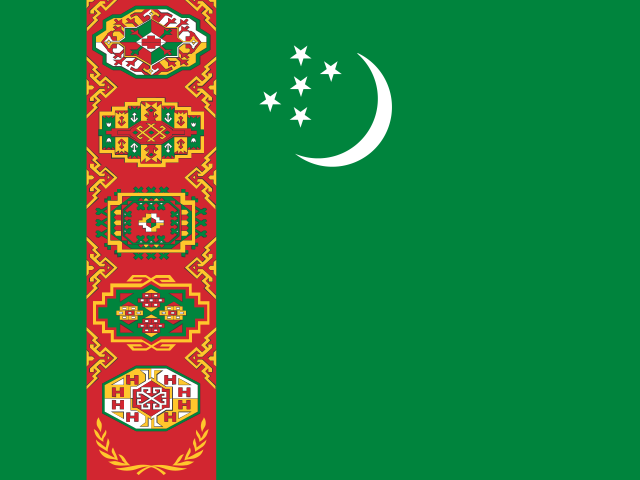
A green field with a vertical crimson carpet stripe near the hoist bearing five guls above two crossed olive branches, and a white crescent with five white stars on the green. The constitution leaves the description of the state symbols to law, and the Law on the State Flag names the five guls for the Ahal Teke, Yomut, Salyr, Chowdur and Arsary and calls them symbols of the friendship and solidarity of the Turkmen people. That law also makes the flag as a whole a symbol of the unity and Independence of the people of Turkmenistan and of the Neutrality of the state, while giving the green, the crescent, the five stars and the olive branches no meaning at all. Reading the five stars for the provinces is convention, and the olive branches, added in 1997, are tied to the neutrality recognised in 1995 by state publications rather than by law.
A continent pretending to be a country - Australia is the only nation that fills an entire continent, with most of its 27 million people clinging to the coast while the red-dirt interior does its own thing.
It's home to the Great Barrier Reef, the largest living structure on Earth.
Around 80% of its mammals, including the kangaroo and koala, live nowhere else on the planet.
Canberra was purpose-built as a compromise capital because Sydney and Melbourne couldn't stop arguing over the honour.
It has more kangaroos than people.
WHAT THE FLAG MEANS
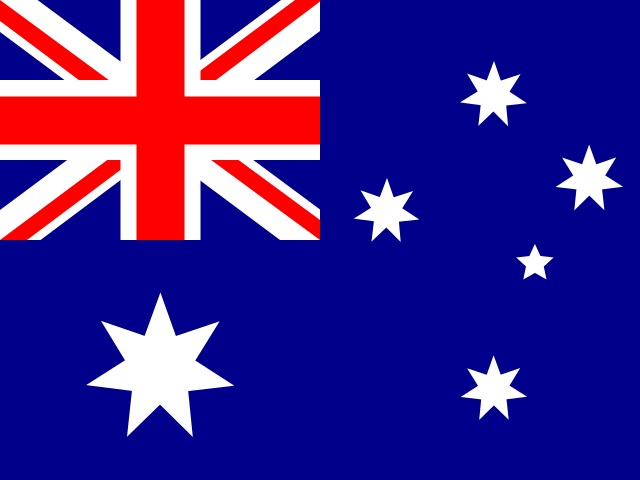
A blue field with the Union Jack in the canton, a large white seven-pointed Commonwealth Star below it, and the five white stars of the Southern Cross at the fly. Six of the big star's points stand for the states and the seventh for the territories; the Southern Cross marks Australia's place in the southern sky.
Population SOURCE Wikidata · flag meaning audited against each country’s own governing instrument · flag: flag-icons (MIT)
The receiver’s side of this corridor
Turkmenistan operates tight exchange controls and holds the manat at an administered rate that has diverged sharply from what the currency fetches unofficially. A quoted figure describes the official rate and little else.
The exchange rate is set on the sending side - by the service the sender chooses in Australia - so the most useful thing a receiver can do happens before the transfer: share the live mid-market rate on this page so the sender can judge the margin in their quote. How the money arrives in Turkmenistan determines any local receiving charges - bank-to-bank transfers can pass through intermediary banks that deduct handling fees.
The Turkmen foreign exchange law of October 2011 is built around a quantity called the limit on freely available currency. It defines it as an amount in the reserve currency, or its equivalent, set by the Central Bank, within which one-time exchange transactions may be carried out without restrictive measures. Two rules then sit on either side of the line and point in opposite directions. Below it, the law says the establishment of personal identification requirements is not allowed except where another statute demands them. Above it, the transaction is performed only after the individual has been identified.
Its value is not published. The Central Bank sets it and does not say what it is: the Bank's legislation index carries three documents in total, its banking-system page returns no information, and the Russian version of the law page returns none either. A figure circulating for the ceiling on foreign currency sold to individuals traces to news outlets and to no instrument, and is not repeated here.
What the law does say plainly is that authorised credit institutions open foreign currency accounts for resident and non-resident individuals without restriction, the one-institution rule in the same article applying to legal entities and sole traders only. A separate article covers transfers made without such an account, capped by the same unreadable limit.
One published figure does exist for money arriving from outside, and it is narrow. A regional anti-money-laundering body recorded in 2023 that a single monthly postal money order from an individual abroad may not exceed the equivalent of fifty US dollars, paid in manat, confined to listed purposes covering pensions, scholarships, alimony, students and parents. Such transfers ran to three countries and were handled at one office in Ashgabat; the underlying order dates from 1994. Reporting on its June 2026 mission, International Monetary Fund staff said exchange restrictions on payments and transfers for current international transactions should be eliminated.
How much Turkmenistani manat will I receive in Turkmenistan?
A little less than the mid-market figures above. The service the sender uses in Australia sets the rate and fees; local receiving banks in Turkmenistan can also apply their own charges depending on how the transfer arrives.
The sender asked for my details - what will they need?
Whatever their transfer service asks for on the receiving side - typically your full legal name and local bank account details in Turkmenistan. Give the name exactly as your bank records it; mismatches are the most common reason a transfer is delayed.
Why did I receive less than the rate on this page suggests?
The mid-market rate is the midpoint between global buy and sell prices, and no retail provider deals at it. The gap between it and a quote is the provider’s margin, which is usually where most of the cost of a transfer sits. On a bank-to-bank transfer an intermediary bank can also deduct a handling charge in transit.