What Kina actually arrives in Papua New Guinea when someone sends Australian dollars, at the live mid-market rate. We explain the process; we never recommend a provider.
1 AUD =
3.1206PGK
▼ -0.52%
STRUCK 11:00 AEST · TUE 13 OCT
3.23153.15023.0688
16 Jul2 Sep13 Oct
What you receive at the mid-market rate
They send (AUD)
You receive at mid-market (PGK)
500 AUD
1,560 PGK
1,000 AUD
3,121 PGK
2,000 AUD
6,241 PGK
5,000 AUD
15,603 PGK
Mid-market equivalents, not transfer quotes - the sender’s provider deducts its margin and any fees before the money reaches you. STRUCK 11:00 AEST · TUE 13 OCT.
Country reference
Papua New Guinea
ISO PG · PNG · Oceania
CAPITAL
Port Moresby
POPULATION
10,762,817 (2025)
CURRENCY
Kina (PGK · K)
AREA
462,840 km²
OFFICIAL LANGUAGES
English, Hiri Motu, Papua New Guinean Sign Language, Tok Pisin
CALLING CODE
+675
TIME ZONES
UTC+10:00, UTC+11:00
Papua New Guinea occupies the eastern half of the world's second-largest island, plus hundreds more, and is one of the most linguistically diverse places anywhere - home to over 800 languages.
More than 800 languages are spoken here, roughly an eighth of all the languages on Earth.
It's home to most of the world's species of birds-of-paradise, famous for their dazzling courtship displays.
Much of its rugged interior remained unknown to the outside world until well into the 20th century.
It shares the island of New Guinea with Indonesia, split almost down the middle.
Its highlands grow prized coffee, a major export from the mountainous interior.
WHAT THE FLAG MEANS
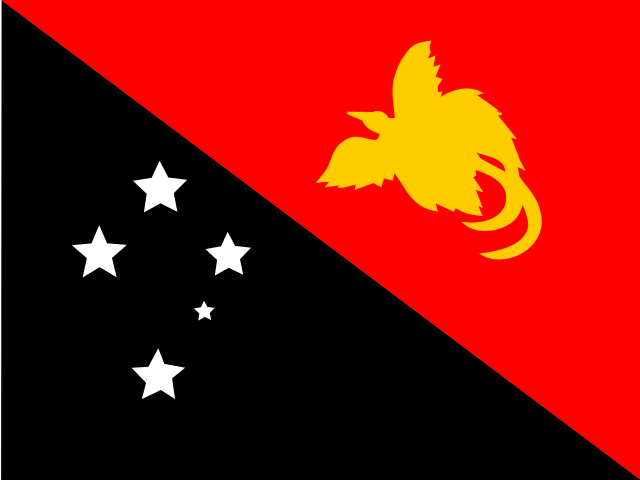
Divided diagonally from upper hoist to lower fly: an upper scarlet segment carrying a soaring mid-yellow bird of paradise, and a lower black segment carrying five white five-pointed stars representing the Southern Cross. The National Identity Act 1971 fixes those colours by reference number and every position as a fraction of the flag's length, and assigns no element a meaning beyond identifying the stars as the Southern Cross; the constitution describes nothing. The design is a schoolgirl's alteration of a flag the constitutional select committee had itself proposed, taken up on that committee's recommendation in 1971, and she described its colours as the ones most commonly used in traditional ceremonies.
Population SOURCE Wikidata · flag meaning audited against each country’s own governing instrument · flag: flag-icons (MIT)
A continent pretending to be a country - Australia is the only nation that fills an entire continent, with most of its 27 million people clinging to the coast while the red-dirt interior does its own thing.
It's home to the Great Barrier Reef, the largest living structure on Earth.
Around 80% of its mammals, including the kangaroo and koala, live nowhere else on the planet.
Canberra was purpose-built as a compromise capital because Sydney and Melbourne couldn't stop arguing over the honour.
It has more kangaroos than people.
WHAT THE FLAG MEANS
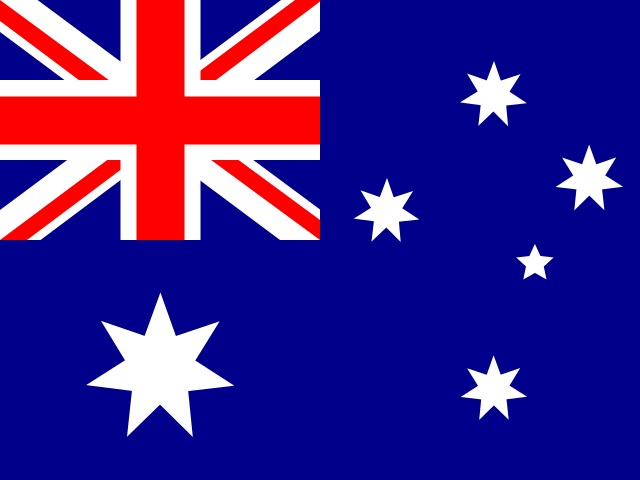
A blue field with the Union Jack in the canton, a large white seven-pointed Commonwealth Star below it, and the five white stars of the Southern Cross at the fly. Six of the big star's points stand for the states and the seventh for the territories; the Southern Cross marks Australia's place in the southern sky.
Population SOURCE Wikidata · flag meaning audited against each country’s own governing instrument · flag: flag-icons (MIT)
The receiver’s side of this corridor
Resources, aid and long-standing family links tie Papua New Guinea and Australia closely together, so this corridor carries business payments as well as personal ones. The kina is not freely convertible, and orders for foreign currency inside the country have faced queues, which shows up in settlement times more than in the headline rate.
The exchange rate is set on the sending side - by the service the sender chooses in Australia - so the most useful thing a receiver can do happens before the transfer: share the live mid-market rate on this page so the sender can judge the margin in their quote. How the money arrives in Papua New Guinea determines any local receiving charges - bank-to-bank transfers can pass through intermediary banks that deduct handling fees.
Once money is inside Papua New Guinea it takes one of two paths, and they behave differently. The Bank of Papua New Guinea's Kina Automated Transfer System runs on a real-time gross settlement basis and is used by commercial banks for interbank transfers, with non-bank institutions reaching it indirectly through those banks. A real-time payment is settled instantly, is irrevocable, and the Bank states it is credited to the payee's account within two hours.
The other path is batched, and its timetable is published. Direct credits, the type used for payroll, salaries and internet and mobile banking transfers, are not settled individually but on a net basis six times a day, in clearing sessions running half an hour from nine, ten and eleven in the morning and from one, two and four in the afternoon. Most are settled the same day they are initiated, and anything submitted late in the day settles the next business day. Neither type carries a minimum or maximum value, so which path a payment takes is the bank's choice rather than a threshold.
Getting the money into the country in the first place is the harder half. The World Bank records that correspondent banking relationships across Pacific island countries fell by 60 per cent over the past decade, against a global average decline of 30 per cent, and reported in September 2025 that Papua New Guinea was joining a regional programme to strengthen them. Fewer intermediary institutions means fewer routes in.
Authority over the currency side sits with the central bank under the Central Banking (Foreign Exchange and Gold) Regulation, which it administers by issuing instructions and requirements to authorised dealers, with the detail carried in its Foreign Exchange Manual, summary guidelines and reporting framework. Papua New Guinea does not appear among the ISO 13616 formats in the IBAN registry, so a sender works from the receiving bank's identifier code and the account number.
A little less than the mid-market figures above. The service the sender uses in Australia sets the rate and fees; local receiving banks in Papua New Guinea can also apply their own charges depending on how the transfer arrives.
The sender asked for my details - what will they need?
Whatever their transfer service asks for on the receiving side - typically your full legal name and local bank account details in Papua New Guinea. Give the name exactly as your bank records it; mismatches are the most common reason a transfer is delayed.
Why did I receive less than the rate on this page suggests?
No retail provider transacts at the mid-market rate - it is the midpoint of the wholesale market. What separates it from a quoted rate is margin, and margin is normally a larger cost than any advertised fee. On a bank-to-bank transfer an intermediary bank can also deduct a handling charge in transit.