What Japanese yen actually arrives in Japan when someone sends Australian dollars, at the live mid-market rate. We explain the process; we never recommend a provider.
1 AUD =
110.46JPY
▲ +0.18%
STRUCK 11:00 AEST · TUE 13 OCT
114.65112.13109.61
16 Jul30 Aug13 Oct
What you receive at the mid-market rate
They send (AUD)
You receive at mid-market (JPY)
500 AUD
55,230 JPY
1,000 AUD
110,460 JPY
2,000 AUD
220,920 JPY
5,000 AUD
552,300 JPY
Mid-market equivalents, not transfer quotes - the sender’s provider deducts its margin and any fees before the money reaches you. STRUCK 11:00 AEST · TUE 13 OCT.
Country reference
Japan
ISO JP · JPN · Asia
CAPITAL
Tokyo
POPULATION
123,366,734 (2025)
CURRENCY
Japanese yen (JPY · ¥)
AREA
377,972 km²
MAIN LANGUAGES
Japanese
CALLING CODE
+81
TIME ZONES
UTC+09:00
An archipelago of more than 14,000 islands where bullet trains, ancient temples and neon cities share the same timetable. Japan turns precision into a national sport.
It's made up of more than 14,000 islands by the latest official count, though most people live on just four of them.
It's home to the world's oldest continuously operating company, founded in 578 AD.
More than 70% of the country is mountainous, which is why its cities crowd the coasts.
It has one of the longest life expectancies of any nation on Earth.
WHAT THE FLAG MEANS
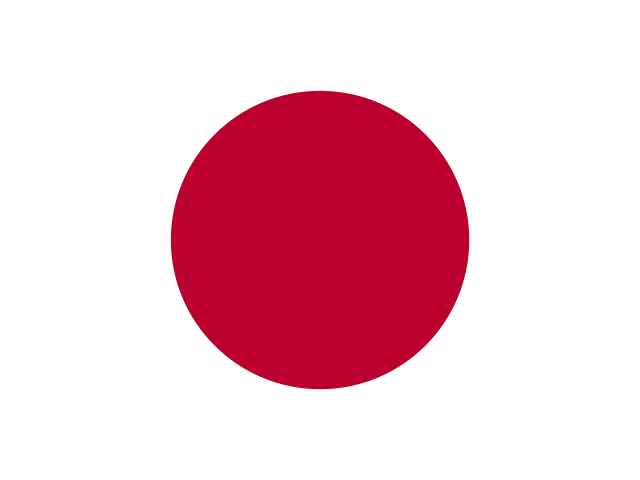
A white field with a large red disc at the centre, the 'Hinomaru', or circle of the sun. The constitution has no flag provision, and before 1999 there was no written rule about the national flag as such: the rule that drew it was an 1870 shipping regulation prescribing the flag merchant ships were to fly. The Act on National Flag and Anthem of 1999 sets the disc at three fifths of the flag's height, centred, and assigns it no meaning. The disc is generally read as the sun, after the name Japan uses for itself; the white ground is left unexplained.
A continent pretending to be a country - Australia is the only nation that fills an entire continent, with most of its 27 million people clinging to the coast while the red-dirt interior does its own thing.
It's home to the Great Barrier Reef, the largest living structure on Earth.
Around 80% of its mammals, including the kangaroo and koala, live nowhere else on the planet.
Canberra was purpose-built as a compromise capital because Sydney and Melbourne couldn't stop arguing over the honour.
It has more kangaroos than people.
WHAT THE FLAG MEANS
A blue field with the Union Jack in the canton, a large white seven-pointed Commonwealth Star below it, and the five white stars of the Southern Cross at the fly. Six of the big star's points stand for the states and the seventh for the territories; the Southern Cross marks Australia's place in the southern sky.
Population SOURCE Wikidata · flag meaning audited against each country’s own governing instrument · flag: flag-icons (MIT)
The receiver’s side of this corridor
Yen amounts are quoted without decimal places and run into the tens of thousands for everyday transfers - check whether a quote is per AUD or per 100 yen when comparing. Japanese banks apply their own inward-remittance handling to foreign currency arriving in a domestic account, so a recipient can be charged at their end on top of whatever the sender paid, which is easy to miss when comparing quotes.
The exchange rate is set on the sending side - by the service the sender chooses in Australia - so the most useful thing a receiver can do happens before the transfer: share the live mid-market rate on this page so the sender can judge the margin in their quote. How the money arrives in Japan determines any local receiving charges - bank-to-bank transfers can pass through intermediary banks that deduct handling fees.
Japan runs two clearing systems, and money from Australia uses the one that domestic transfers never touch. The Bank of Japan names both as the country's private-sector deferred net settlement systems: the Zengin System, operated by Zengin-Net and carrying domestic credit transfers between participant banks, and the Foreign Exchange Yen Clearing System, operated by the Japanese Bankers Association with its operations consigned to the Bank of Japan. The Bankers Association describes the second as the means by which yen transfers requested by companies or individuals overseas are centrally cleared between banks.
Zengin has run around the clock since the More Time System began in October 2018, though Zengin-Net records that this availability covers telegraphic transfers under one hundred million yen, with larger amounts settling through the central bank. A sender outside Japan reaches none of it. What arrives comes in on the foreign exchange side and is credited by the receiving bank on its own business cycle, which is why a payment sent on a Japanese public holiday behaves quite unlike a domestic one sent the same afternoon.
The name an account is held under follows from the record format. The Japanese Bankers Association's own standard limits the account-name field to katakana, voiced marks and a small set of symbols, excluding kanji and hiragana, which is why a Japanese account is registered in katakana whatever the holder's name looks like written out.
A duty then falls on the person in Japan. The Bank of Japan states that a payment or receipt between a resident and a non-resident above the equivalent of thirty million yen is reported to the Minister of Finance through the Bank.
A little less than the mid-market figures above. The service the sender uses in Australia sets the rate and fees; local receiving banks in Japan can also apply their own charges depending on how the transfer arrives.
The sender asked for my details - what will they need?
Whatever their transfer service asks for on the receiving side - typically your full legal name and local bank account details in Japan. Give the name exactly as your bank records it; mismatches are the most common reason a transfer is delayed.
Why did I receive less than the rate on this page suggests?
A quote is the mid-market rate with the provider’s margin taken out of it. Because that margin is expressed in the rate rather than itemised, it is easy to miss and is usually the bigger half of what a transfer costs. On a bank-to-bank transfer an intermediary bank can also deduct a handling charge in transit.