What Gambian dalasi actually arrives in the Gambia when someone sends Australian dollars, at the live mid-market rate. We explain the process; we never recommend a provider.
1 AUD =
50.85GMD
▼ -0.04%
STRUCK 11:00 AEST · TUE 13 OCT
53.151.8250.55
16 Jul2 Sep13 Oct
What you receive at the mid-market rate
They send (AUD)
You receive at mid-market (GMD)
500 AUD
25,426 GMD
1,000 AUD
50,852 GMD
2,000 AUD
101,704 GMD
5,000 AUD
254,260 GMD
Mid-market equivalents, not transfer quotes - the sender’s provider deducts its margin and any fees before the money reaches you. STRUCK 11:00 AEST · TUE 13 OCT.
Country reference
The Gambia
ISO GM · GMB · Africa
CAPITAL
Banjul
POPULATION
2,822,093 (2025)
CURRENCY
Dalasi (GMD · D)
AREA
11,300 km²
OFFICIAL LANGUAGES
English
CALLING CODE
+220
TIME ZONES
UTC±00:00
The smallest country on mainland Africa, The Gambia is essentially a ribbon of land wrapped around its namesake river, almost completely surrounded by Senegal.
It is the smallest country on the African mainland.
The nation is a narrow strip following the River Gambia and is enclosed by Senegal on nearly every side.
It is one of Africa's top destinations for birdwatchers, with hundreds of species recorded in a tiny area.
The river that names it is navigable far inland, historically making it a key trade artery.
WHAT THE FLAG MEANS
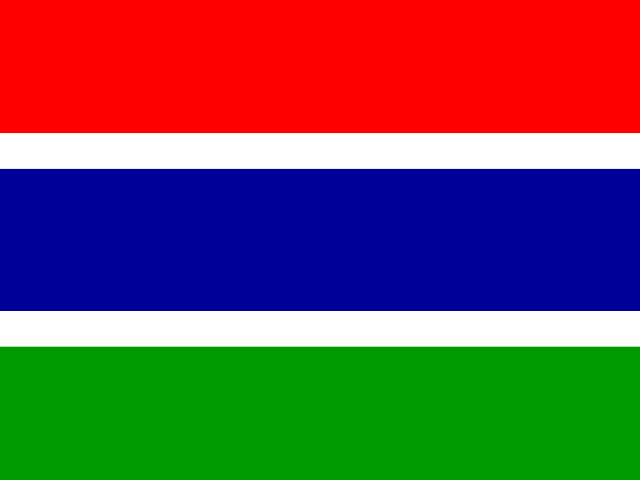
Red, blue and green horizontal bands separated by thin white stripes. Schedule 1 to the constitution sets the flag at twenty-seven units across by eighteen down and gives each stripe its width from the top - red six units one third, white one, blue four units one third, white one, green six units one third - and assigns no colour a meaning. Those five widths sum to nineteen units, one more than the depth the same schedule gives the flag, and nothing in it resolves the difference. The colours are conventionally read as red for the sun and savannah, the central blue band for the River Gambia, green for the land and forests, and the white lines for unity and peace, and none of those readings is in any Gambian instrument.
Population SOURCE Wikidata · flag meaning audited against each country’s own governing instrument · flag: flag-icons (MIT)
A continent pretending to be a country - Australia is the only nation that fills an entire continent, with most of its 27 million people clinging to the coast while the red-dirt interior does its own thing.
It's home to the Great Barrier Reef, the largest living structure on Earth.
Around 80% of its mammals, including the kangaroo and koala, live nowhere else on the planet.
Canberra was purpose-built as a compromise capital because Sydney and Melbourne couldn't stop arguing over the honour.
It has more kangaroos than people.
WHAT THE FLAG MEANS
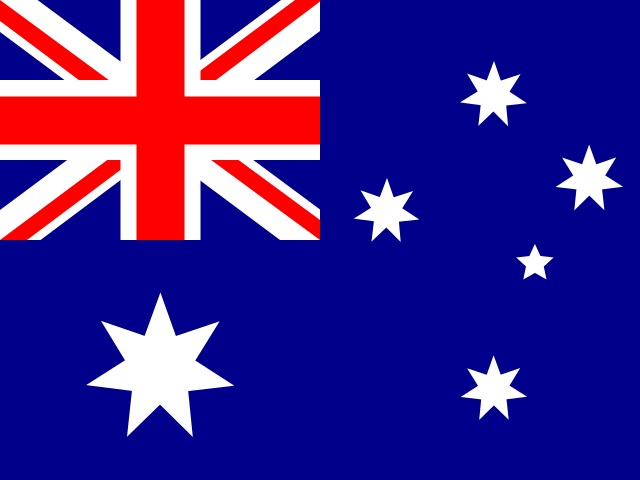
A blue field with the Union Jack in the canton, a large white seven-pointed Commonwealth Star below it, and the five white stars of the Southern Cross at the fly. Six of the big star's points stand for the states and the seventh for the territories; the Southern Cross marks Australia's place in the southern sky.
Population SOURCE Wikidata · flag meaning audited against each country’s own governing instrument · flag: flag-icons (MIT)
The receiver’s side of this corridor
The Gambia is wrapped almost entirely by Senegal, which uses the West African CFA franc, leaving the dalasi a small currency island with a different currency on every land border. Tourism and money sent home by Gambians abroad supply a large share of the country’s foreign exchange.
The exchange rate is set on the sending side - by the service the sender chooses in Australia - so the most useful thing a receiver can do happens before the transfer: share the live mid-market rate on this page so the sender can judge the margin in their quote. How the money arrives in the Gambia determines any local receiving charges - bank-to-bank transfers can pass through intermediary banks that deduct handling fees.
Who is actually allowed to convert the money and hand it over
Whoever takes the money in Australia is, under Gambian rules, a conduit and nothing more. The Central Bank of The Gambia's Foreign Exchange Policy of December 2023 states that participation in the foreign exchange market requires a licence from the Bank, and that international money transfer operators and financial technology companies are just conduits of remittance transfers and shall not engage in the buying and selling of foreign exchange currencies in the domestic market. The party that converts the money and hands it over is always an institution the Bank has licensed.
Often that institution is a bureau rather than a bank. The same policy names the licensed participants as commercial banks, foreign exchange bureaux, microfinance institutions, mobile money operators and money transfer operators, describes banks as the largest participants and bureaux as the second largest, and records that some foreign exchange bureaux serve as agents of money transfer operators. The counter a recipient walks up to is frequently one of those.
The national infrastructure behind them keeps office hours. The Bank lists four systems - real-time gross settlement, securities settlement, automated cheque processing and clearing, and the card switch - and states that they operate on each business day of the week, excluding Saturdays, Sundays and public holidays. Money that must clear domestically therefore does not move over a Gambian weekend or public holiday. The switch itself is now fully owned by the Central Bank, has connectivity to all the commercial banks, and settles through the Bank's own settlement system.
How much Gambian dalasi will I receive in the Gambia?
A little less than the mid-market figures above. The service the sender uses in Australia sets the rate and fees; local receiving banks in the Gambia can also apply their own charges depending on how the transfer arrives.
The sender asked for my details - what will they need?
Whatever their transfer service asks for on the receiving side - typically your full legal name and local bank account details in the Gambia. Give the name exactly as your bank records it; mismatches are the most common reason a transfer is delayed.
Why did I receive less than the rate on this page suggests?
Retail rates are set away from the mid-market midpoint by a margin the provider keeps. Comparing a quote against the reference rate on this page is what makes that margin visible, since it is rarely stated as a fee. On a bank-to-bank transfer an intermediary bank can also deduct a handling charge in transit.