Receiving Australian dollars in the Democratic Republic of the Congo
What Congolese franc actually arrives in the Democratic Republic of the Congo when someone sends Australian dollars, at the live mid-market rate. We explain the process; we never recommend a provider.
1 AUD =
1,596.65CDF
▼ -0.01%
STRUCK 11:00 AEST · TUE 13 OCT
1,655.571,617.561,579.55
16 Jul2 Sep13 Oct
What you receive at the mid-market rate
They send (AUD)
You receive at mid-market (CDF)
500 AUD
798,325 CDF
1,000 AUD
1,596,650 CDF
2,000 AUD
3,193,300 CDF
5,000 AUD
7,983,250 CDF
Mid-market equivalents, not transfer quotes - the sender’s provider deducts its margin and any fees before the money reaches you. STRUCK 11:00 AEST · TUE 13 OCT.
Country reference
Democratic Republic of the Congo
ISO CD · COD · Africa
CAPITAL
Kinshasa
POPULATION
112,832,473 (2025)
CURRENCY
Congolese franc (CDF · CF)
AREA
2,344,858 km²
OFFICIAL LANGUAGES
French
CALLING CODE
+243
TIME ZONES
UTC+01:00, UTC+02:00
A giant straddling the equator, the Democratic Republic of the Congo is the second-largest country in Africa, laced by the mighty Congo River and cloaked in the world's second-largest rainforest.
It's the second-largest country in Africa by area.
The Congo River is the deepest river in the world and the second longest in Africa.
It holds much of the Congo Basin, the world's second-largest tropical rainforest after the Amazon.
It's the only place in the wild where the bonobo, one of humanity's closest relatives, lives.
The okapi, a forest relative of the giraffe, is found only here.
WHAT THE FLAG MEANS
A sky-blue field crossed by a red diagonal stripe (edged in yellow) running from the lower hoist to the upper fly, with a yellow five-pointed star in the upper hoist corner. Article 1 of the constitution of 18 February 2006 sets out that design and assigns the colours no meaning at all. The readings in circulation come from the Presidency of the Republic, whose sheet on the national symbols gives blue for peace, the red band for the blood of the martyrs, yellow for the country's wealth, and the star for a country united and promised a radiant future.
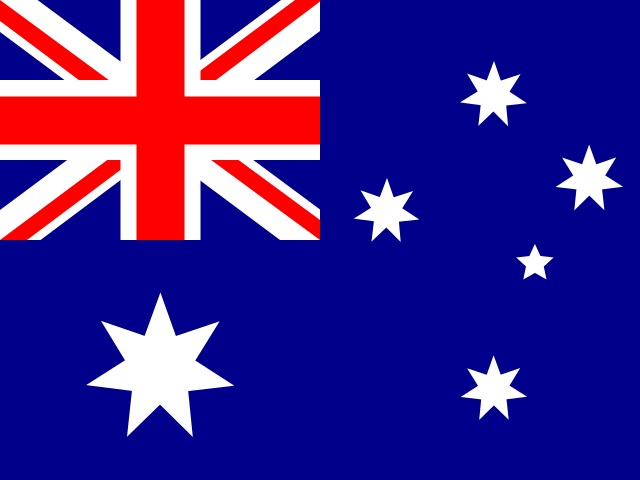
A continent pretending to be a country - Australia is the only nation that fills an entire continent, with most of its 27 million people clinging to the coast while the red-dirt interior does its own thing.
It's home to the Great Barrier Reef, the largest living structure on Earth.
Around 80% of its mammals, including the kangaroo and koala, live nowhere else on the planet.
Canberra was purpose-built as a compromise capital because Sydney and Melbourne couldn't stop arguing over the honour.
It has more kangaroos than people.
WHAT THE FLAG MEANS
A blue field with the Union Jack in the canton, a large white seven-pointed Commonwealth Star below it, and the five white stars of the Southern Cross at the fly. Six of the big star's points stand for the states and the seventh for the territories; the Southern Cross marks Australia's place in the southern sky.
Population SOURCE Wikidata · flag meaning audited against each country’s own governing instrument · flag: flag-icons (MIT)
The receiver’s side of this corridor
Larger payments in the Democratic Republic of the Congo are commonly settled in US dollars, with Congolese francs handling everyday retail, so the currency a recipient actually wants is worth establishing first. Franc figures are quoted in thousands, and cash habits in the mining provinces differ from those in Kinshasa.
The exchange rate is set on the sending side - by the service the sender chooses in Australia - so the most useful thing a receiver can do happens before the transfer: share the live mid-market rate on this page so the sender can judge the margin in their quote. How the money arrives in the Democratic Republic of the Congo determines any local receiving charges - bank-to-bank transfers can pass through intermediary banks that deduct handling fees.
The identity document a Congolese recipient presents is younger than most of the people carrying it. The National Office for Identification of the Population was created by decree on 2 March 2022, with a mandate covering the systematic and effective identification of the Congolese population living in the country and abroad, together with the identification of foreign residents. Its own account of what it inherited is blunt: for nearly half a century, Congolese people had not had an identity card.
The card it issues is compulsory for adult citizens and valid for ten years, and it is issued only to people already registered in the general population file. Enrolment in that file is therefore a precondition of holding the card rather than a by-product of applying for it, which is a distinction that matters to anyone being asked to produce one at a counter.
The payment law is older and unusually broad about who may take part. The law of 9 July 2018 on payment and securities settlement systems lists the participants in a payment system as the central bank, the public treasury, credit institutions, central counterparties, a system's settlement agent, system operators, the financial services of the post office, and other issuers of payment instruments. It puts one or more payment systems in the central bank's own hands, requires the rules of systems operated by others to be approved in advance, and requires the central bank's approval before an interoperability agreement with a foreign depository or settlement system takes effect.
How much Congolese franc will I receive in the Democratic Republic of the Congo?
A little less than the mid-market figures above. The service the sender uses in Australia sets the rate and fees; local receiving banks in the Democratic Republic of the Congo can also apply their own charges depending on how the transfer arrives.
The sender asked for my details - what will they need?
Whatever their transfer service asks for on the receiving side - typically your full legal name and local bank account details in the Democratic Republic of the Congo. Give the name exactly as your bank records it; mismatches are the most common reason a transfer is delayed.
Why did I receive less than the rate on this page suggests?
The mid-market rate is the midpoint between global buy and sell prices, and no retail provider deals at it. The gap between it and a quote is the provider’s margin, which is usually where most of the cost of a transfer sits. On a bank-to-bank transfer an intermediary bank can also deduct a handling charge in transit.