The live mid-market AUD→LKR rate and what it means for a transfer to Sri Lanka. We explain the process; we never recommend a provider.
1 AUD =
230.41LKR
▲ +0.07%
STRUCK 11:00 AEST · TUE 13 OCT
237.21233.37229.52
16 Jul2 Sep13 Oct
What arrives at the mid-market rate
You send (AUD)
Mid-market equivalent (LKR)
500 AUD
115,205 LKR
1,000 AUD
230,410 LKR
2,000 AUD
460,820 LKR
5,000 AUD
1,152,050 LKR
These are mid-market equivalents, not transfer quotes - a provider deducts its exchange-rate margin and any fee from these figures. STRUCK 11:00 AEST · TUE 13 OCT.
A continent pretending to be a country - Australia is the only nation that fills an entire continent, with most of its 27 million people clinging to the coast while the red-dirt interior does its own thing.
It's home to the Great Barrier Reef, the largest living structure on Earth.
Around 80% of its mammals, including the kangaroo and koala, live nowhere else on the planet.
Canberra was purpose-built as a compromise capital because Sydney and Melbourne couldn't stop arguing over the honour.
It has more kangaroos than people.
WHAT THE FLAG MEANS
A blue field with the Union Jack in the canton, a large white seven-pointed Commonwealth Star below it, and the five white stars of the Southern Cross at the fly. Six of the big star's points stand for the states and the seventh for the territories; the Southern Cross marks Australia's place in the southern sky.
Population SOURCE Wikidata · flag meaning audited against each country’s own governing instrument · flag: flag-icons (MIT)
Country reference
Sri Lanka
ISO LK · LKA · Asia
CAPITAL
Colombo
POPULATION
21,756,000 (2025)
CURRENCY
Sri Lankan rupee (LKR · Rs)
AREA
65,610 km²
OFFICIAL LANGUAGES
Sinhala, Tamil
CALLING CODE
+94
TIME ZONES
UTC+05:30
A teardrop-shaped island off the tip of India, Sri Lanka grows some of the world's most famous tea, guards ancient rock fortresses, and shelters both elephants and blue whales.
It's one of the world's largest exporters of tea, known globally as Ceylon tea.
The ancient rock fortress of Sigiriya rises about 200 metres from the plains and dates to the 5th century.
The waters off its coast are among the best places on Earth to see blue whales, the largest animals ever to have lived.
It was known as Ceylon until 1972.
Cinnamon originally came from Sri Lanka, which was once a prized source of the spice.
WHAT THE FLAG MEANS
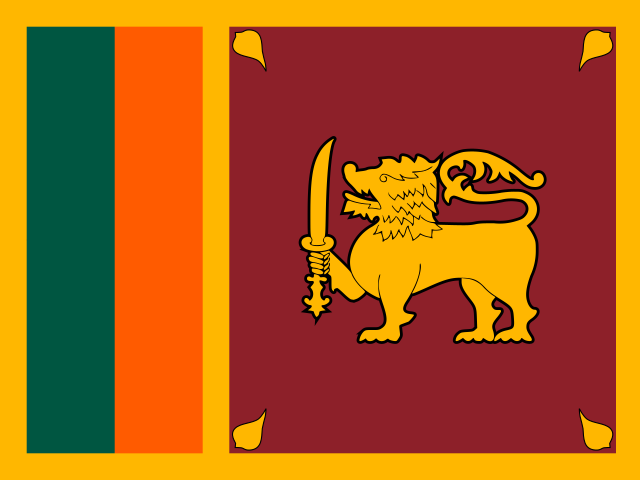
A maroon field with a yellow lion holding a sword and a yellow bo leaf in each of the field's four corners, beside two vertical stripes of green and orange at the hoist, all within a yellow border. Article 6 of the constitution prescribes the flag by reproducing it in the Second Schedule as a picture, with no words describing it and none assigning it a meaning. The government's own account supplies the readings instead: the lion for the Sinhalese and the sword for sovereignty, the bo leaves for Buddhism and for four Buddhist virtues, the orange stripe for the Tamil community and the green for the Muslim community, the maroon for the country's other religions and the yellow border for its other communities.
Population SOURCE Wikidata · flag meaning audited against each country’s own governing instrument · flag: flag-icons (MIT)
About this corridor
Sri Lanka’s rupee has moved through sharp repricings rather than gentle drift, so a rate checked weeks ago is a poor guide to today’s. Recipients are often paid into rupee accounts that carry their own inward-transfer handling, separate from anything the sender pays.
Australia’s exchange controls went with the float. A Reserve Bank research paper dates their abolition to the December 1983 decision that ended the crawling peg and opened the country to capital moving in both directions. Sanctions are a separate matter and do still apply. Targeted financial sanctions prohibit making assets available to designated persons and entities, and the Australian Sanctions Office within the Department of Foreign Affairs and Trade maintains the Consolidated List that names them. The other requirement sits with the provider rather than the sender. Before it carries out a first transfer the provider must complete customer identification: collect identifying information, then verify it against reliable and independent documents or electronic data. That is the request for identity documents a first-time sender meets before anything can be sent.
The report that follows is the provider’s, not yours. A reporting entity must lodge an international funds transfer instruction report with AUSTRAC for a transfer of any value into or out of Australia, within ten business days of the instruction. There is no amount below which one is not filed, and on a transfer sent through a provider there is nothing for the sender to lodge. What is left to a sender is timing and route. The banking day that decides when money lands is the destination’s, not Australia’s, and Australian business hours run ahead of nearly every country on this list: Monday morning in Sydney is still Sunday in the Americas. The Committee on Payments and Market Infrastructures records that payments reaching a beneficiary country outside its operating hours stall until the system reopens. Route matters as much as the hour. A payment may pass through correspondent banks on its way, or through a provider that operates in both countries and, the Reserve Bank notes, avoids some of the costs of that intermediation.
How much Sri Lankan rupee will the recipient actually get?
A little less than the mid-market figures on this page. Providers apply their own exchange rate (the mid-market rate minus a margin) and usually a transfer fee, so the amount that arrives in Sri Lanka depends on both. Comparing a provider's quote against the mid-market rate shown here reveals the real cost.
Is there a best day to send money to Sri Lanka?
Rates move constantly and Tradergy doesn't forecast them. What you can control is the cost of the transfer itself: the gap between the quoted rate and the mid-market rate, plus any fees.
Why is my provider’s rate worse than this one?
The mid-market rate is the midpoint between global buy and sell prices, and no retail provider deals at it. The gap between it and a quote is the provider’s margin, which is usually where most of the cost of a transfer sits.