The live mid-market AUD→INR rate and what it means for a transfer to India. We explain the process; we never recommend a provider.
1 AUD =
67.02INR
▼ -0.50%
STRUCK 11:00 AEST · TUE 13 OCT
68.5967.5966.59
16 Jul30 Aug13 Oct
What arrives at the mid-market rate
You send (AUD)
Mid-market equivalent (INR)
500 AUD
33,511 INR
1,000 AUD
67,021 INR
2,000 AUD
134,042 INR
5,000 AUD
335,105 INR
These are mid-market equivalents, not transfer quotes - a provider deducts its exchange-rate margin and any fee from these figures. STRUCK 11:00 AEST · TUE 13 OCT.
A continent pretending to be a country - Australia is the only nation that fills an entire continent, with most of its 27 million people clinging to the coast while the red-dirt interior does its own thing.
It's home to the Great Barrier Reef, the largest living structure on Earth.
Around 80% of its mammals, including the kangaroo and koala, live nowhere else on the planet.
Canberra was purpose-built as a compromise capital because Sydney and Melbourne couldn't stop arguing over the honour.
It has more kangaroos than people.
WHAT THE FLAG MEANS
A blue field with the Union Jack in the canton, a large white seven-pointed Commonwealth Star below it, and the five white stars of the Southern Cross at the fly. Six of the big star's points stand for the states and the seventh for the territories; the Southern Cross marks Australia's place in the southern sky.
Population SOURCE Wikidata · flag meaning audited against each country’s own governing instrument · flag: flag-icons (MIT)
Country reference
India
ISO IN · IND · Asia
CAPITAL
New Delhi
POPULATION
1,463,865,525 (2025)
CURRENCY
Indian rupee (INR · ₹)
AREA
3,287,263 km²
OFFICIAL LANGUAGES
English, Hindi
CALLING CODE
+91
TIME ZONES
UTC+05:30
The world's most populous country and largest democracy, home to more than 1.4 billion people, hundreds of languages and the source of the very number system you count with.
It is the most populous country on Earth, home to more than 1.4 billion people.
The decimal number system and the concept of zero were developed by Indian mathematicians.
It has no single national language, but recognises 22 official languages in its constitution.
The Kumbh Mela is the largest human gathering on the planet, drawing tens of millions of pilgrims.
Chess evolved from an ancient Indian game called chaturanga.
WHAT THE FLAG MEANS
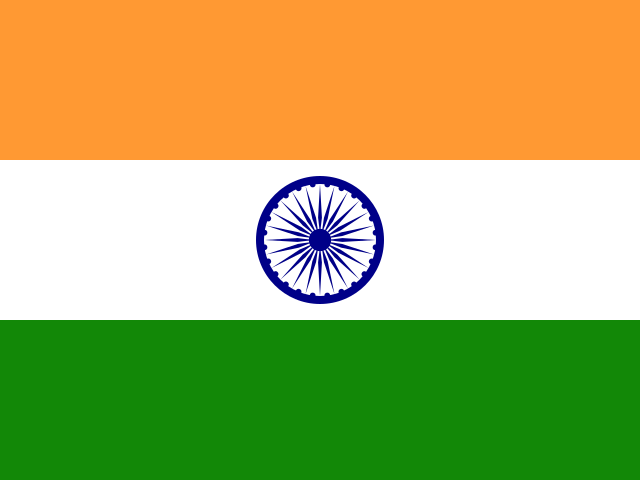
Three horizontal bands of India saffron, white and India green, with a navy-blue twenty-four-spoke Ashoka Chakra centred in the white band. The constitution refers to the National Flag only in the fundamental duties, which require every citizen to respect it, and never describes it or assigns it a meaning; the resolution that adopted the flag in 1947 describes the design in detail and says only that the wheel represents the charkha. The colours are conventionally read as saffron for renunciation, white for the path of truth and green for the relation to the soil, and the wheel as the wheel of the law of dharma, a reading taken from one member's speech in that debate rather than from any instrument.
Population SOURCE Wikidata · flag meaning audited against each country’s own governing instrument · flag: flag-icons (MIT)
About this corridor
Australia-India is one of the busiest remittance corridors out of Australia, and rupee amounts run large - a modest AUD transfer becomes a five- or six-figure INR sum. India requires the purpose of an inbound transfer to be declared and matched to the receiving account, so the recipient’s side of the paperwork is usually what decides how fast a transfer clears rather than the sending end. The annual limit people have in mind runs the other way: it caps what an Indian resident may send abroad, not what they may receive.
Australia’s exchange controls went with the float. A Reserve Bank research paper dates their abolition to the December 1983 decision that ended the crawling peg and opened the country to capital moving in both directions. Sanctions are a separate matter and do still apply. Targeted financial sanctions prohibit making assets available to designated persons and entities, and the Australian Sanctions Office within the Department of Foreign Affairs and Trade maintains the Consolidated List that names them. The other requirement sits with the provider rather than the sender. Before it carries out a first transfer the provider must complete customer identification: collect identifying information, then verify it against reliable and independent documents or electronic data. That is the request for identity documents a first-time sender meets before anything can be sent.
The report that follows is the provider’s, not yours. A reporting entity must lodge an international funds transfer instruction report with AUSTRAC for a transfer of any value into or out of Australia, within ten business days of the instruction. There is no amount below which one is not filed, and on a transfer sent through a provider there is nothing for the sender to lodge. What is left to a sender is timing and route. The banking day that decides when money lands is the destination’s, not Australia’s, and Australian business hours run ahead of nearly every country on this list: Monday morning in Sydney is still Sunday in the Americas. The Committee on Payments and Market Infrastructures records that payments reaching a beneficiary country outside its operating hours stall until the system reopens. Route matters as much as the hour. A payment may pass through correspondent banks on its way, or through a provider that operates in both countries and, the Reserve Bank notes, avoids some of the costs of that intermediation.
New to sending money to India? The corridor guide walks through how a transfer works and what to check. Where to go next: the INR → AUD page covers the opposite direction, the AUD/INR converter page has amount conversion and history, and the currency converter handles any amount. On the other end of this transfer? The receiver’s view covers what arrives and what to check.
How much Indian rupee will the recipient actually get?
A little less than the mid-market figures on this page. Providers apply their own exchange rate (the mid-market rate minus a margin) and usually a transfer fee, so the amount that arrives in India depends on both. Comparing a provider's quote against the mid-market rate shown here reveals the real cost.
Is there a best day to send money to India?
Rates move constantly and Tradergy doesn't forecast them. What you can control is the cost of the transfer itself: the gap between the quoted rate and the mid-market rate, plus any fees.
Why is my provider’s rate worse than this one?
The mid-market rate is the midpoint between global buy and sell prices, and no retail provider deals at it. The gap between it and a quote is the provider’s margin, which is usually where most of the cost of a transfer sits.