What lands in Australia when someone sends Boliviano: the live mid-market BOB→AUD rate, the details to give the sender, and the receiving-end fees to check.
1 BOB =
0.1219AUD
▲ +0.66%
STRUCK 11:00 AEST · TUE 13 OCT
0.16080.13540.11
16 Jul2 Sep13 Oct
What you receive at the mid-market rate
They send (BOB)
You receive at mid-market (AUD)
1,000 BOB
122 AUD
5,000 BOB
610 AUD
10,000 BOB
1,219 AUD
50,000 BOB
6,095 AUD
Mid-market equivalents, not transfer quotes - the sender’s provider deducts its margin and any fees before the money reaches you. STRUCK 11:00 AEST · TUE 13 OCT.
A continent pretending to be a country - Australia is the only nation that fills an entire continent, with most of its 27 million people clinging to the coast while the red-dirt interior does its own thing.
It's home to the Great Barrier Reef, the largest living structure on Earth.
Around 80% of its mammals, including the kangaroo and koala, live nowhere else on the planet.
Canberra was purpose-built as a compromise capital because Sydney and Melbourne couldn't stop arguing over the honour.
It has more kangaroos than people.
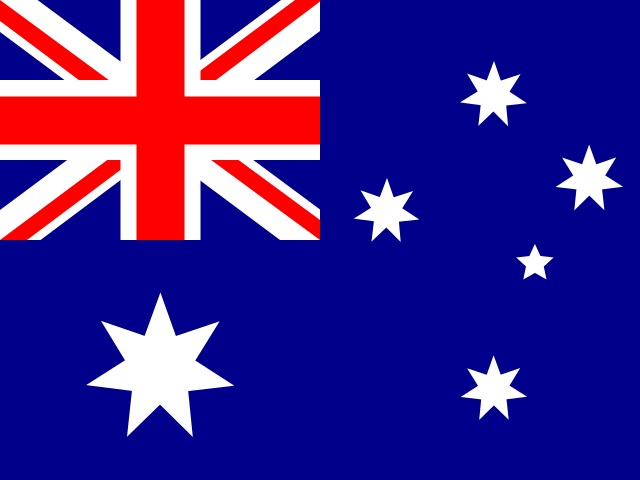
WHAT THE FLAG MEANS
A blue field with the Union Jack in the canton, a large white seven-pointed Commonwealth Star below it, and the five white stars of the Southern Cross at the fly. Six of the big star's points stand for the states and the seventh for the territories; the Southern Cross marks Australia's place in the southern sky.
Population SOURCE Wikidata · flag meaning audited against each country’s own governing instrument · flag: flag-icons (MIT)
Country reference
Bolivia
ISO BO · BOL · South America
CAPITAL
Sucre
POPULATION
12,581,843 (2025)
CURRENCY
Boliviano (BOB · Bs)
AREA
1,098,581 km²
OFFICIAL LANGUAGES
Araona, Aymara, Baure, Bésiro, Canichana, Cavineño and 31 more
CALLING CODE
+591
TIME ZONES
UTC-04:00
A high-altitude South American country with two capitals and a mirror-flat salt desert you can see from space. Bolivia keeps its government in La Paz but its constitution in Sucre.
The Salar de Uyuni is the world's largest salt flat, turning into a giant mirror after rain.
La Paz is the highest administrative capital on Earth, sitting over 3,600 metres above sea level.
Lake Titicaca, which it shares with Peru, is the highest navigable lake in the world.
Bolivia has two capitals: Sucre is constitutional, while La Paz holds the government.
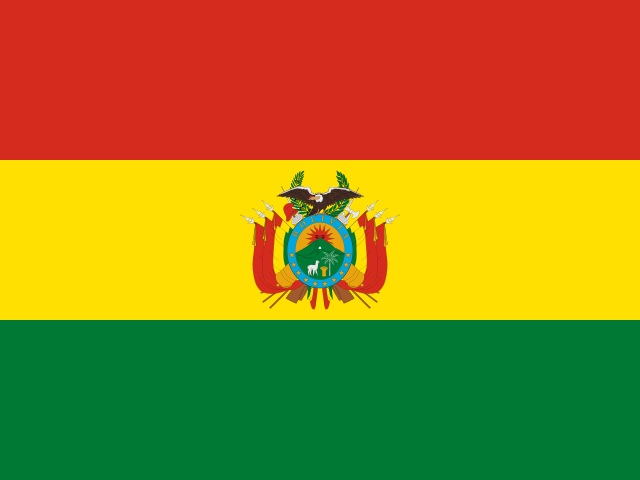
WHAT THE FLAG MEANS
Three horizontal bands of red, yellow and green. The 2009 constitution names the tricolour a symbol of the State but assigns the colours no meaning; a supreme decree of the same year supplies one, giving red the blood shed by the nation's heroes for the birth and preservation of the Republic and the consolidation of the Plurinational State, yellow the mineral and subsoil riches of the Bolivian people, and green the wealth of nature and hope. The coat of arms sits at the centre of the yellow band only on the flags of state institutions and the armed forces, not on the plain tricolour that citizens fly. Bolivia has a second official flag: the same constitutional article also names the wiphala, a square seven-by-seven chequered banner of forty-nine coloured squares, and it is hoisted beside the tricolour on central-government buildings.
Population SOURCE Wikidata · flag meaning audited against each country’s own governing instrument · flag: flag-icons (MIT)
The receiver’s side of this corridor
Bolivia held the boliviano at an effectively unchanged official rate against the US dollar from 2011 until 2026, when it moved to a flexible exchange market, so this pair now moves on both sides rather than tracking the Australian dollar alone. Hard currency has been scarce inside the country, which affects what a recipient can do with the money more than the quote does.
An Australian account is addressed by two numbers and a code. The BSB is issued by the Australian Payments Network to each member of the domestic clearing system and routes the payment to the right destination. The account number identifies the account behind it. The bank’s SWIFT/BIC, eight or eleven characters of institution, country and location, identifies the bank itself. What a sender abroad will not get is an IBAN. Those formats are registered country by country under ISO 13616, only a national standards body or central bank can register one, and the registry Swift publishes holds eighty-nine countries with Australia not among them. Nor is a PayID the answer. PayID is an addressing option inside the New Payments Platform, Australia’s domestic system, offered alongside the BSB and account number rather than instead of them.
The name matters more than most senders expect. Australia has an industry name check, Confirmation of Payee, launched in July 2025: it verifies entered account details against those the recipient’s bank holds and displays a match outcome. Its scope is payments addressed to a BSB and account number over the New Payments Platform and the Bulk Electronic Clearing System. Those are the domestic rails, so the check sits on an Australian payer’s instruction, not on one given overseas, and it does not cover the inbound leg even where that leg runs over the same platform. The name given abroad has to match the account exactly, and the Reserve Bank lists messaging errors and inconsistencies among the frictions that slow a cross-border payment. The route matters too. The Reserve Bank’s account is that a payment often flows through one or more correspondent banks to reach its destination, adding to the cost and the time. The last leg has changed most. Under the International Payments Service a participating Australian institution can carry the final domestic leg over the New Payments Platform. Of the payments sent that way in December 2025, more than half arrived sooner than they would have through the older high-value route.
The exchange rate is set on the sending side - by the service the sender chooses in Bolivia - so the most useful thing a receiver can do happens before the transfer: share the live mid-market rate on this page so the sender can judge the margin in their quote. On arrival, check whether your bank charges an inbound international (SWIFT) fee - transfers sent via modern services often arrive as domestic payments and avoid it.
What details do I give someone sending money from Bolivia?
Your full name exactly as it appears on the account, your BSB and account number, and your bank’s SWIFT/BIC code. There is no Australian IBAN to give.
How many Australian dollars will actually arrive?
A little less than the mid-market figures on this page. The sender's service sets the exchange rate (mid-market minus its margin) and any fees before the money leaves Bolivia; your own bank may also charge an inbound international transfer fee.
Can I do anything about the rate as the receiver?
Not after it’s sent - the rate is locked on the sender’s side. What helps is before the transfer: share this page’s live mid-market rate with the sender so they can see the margin in any quote they’re given.